

Choosing between outsourced and in-house behavioral health billing affects revenue, staffing, and day-to-day operations. Behavioral health has unique coding, prior authorizations, and documentation rules. This guide gives a balanced view so you can pick a billing model that fits your goals.
In-house vs. outsourced billing: what’s the difference?
In-house billing means your team handles the billing process from end to end. You choose the billing software, build workflows, and set internal controls for billing operations. Outsourcing billing means a third party service handles some or all steps.
Where behavioral health is different than other medical services
Mental health billing often relies on time-based psychotherapy codes, group therapy, IOP, and PHP services. Documentation and coordination with therapists and psychiatrists must be tight to protect cash flow and minimize denied claims.
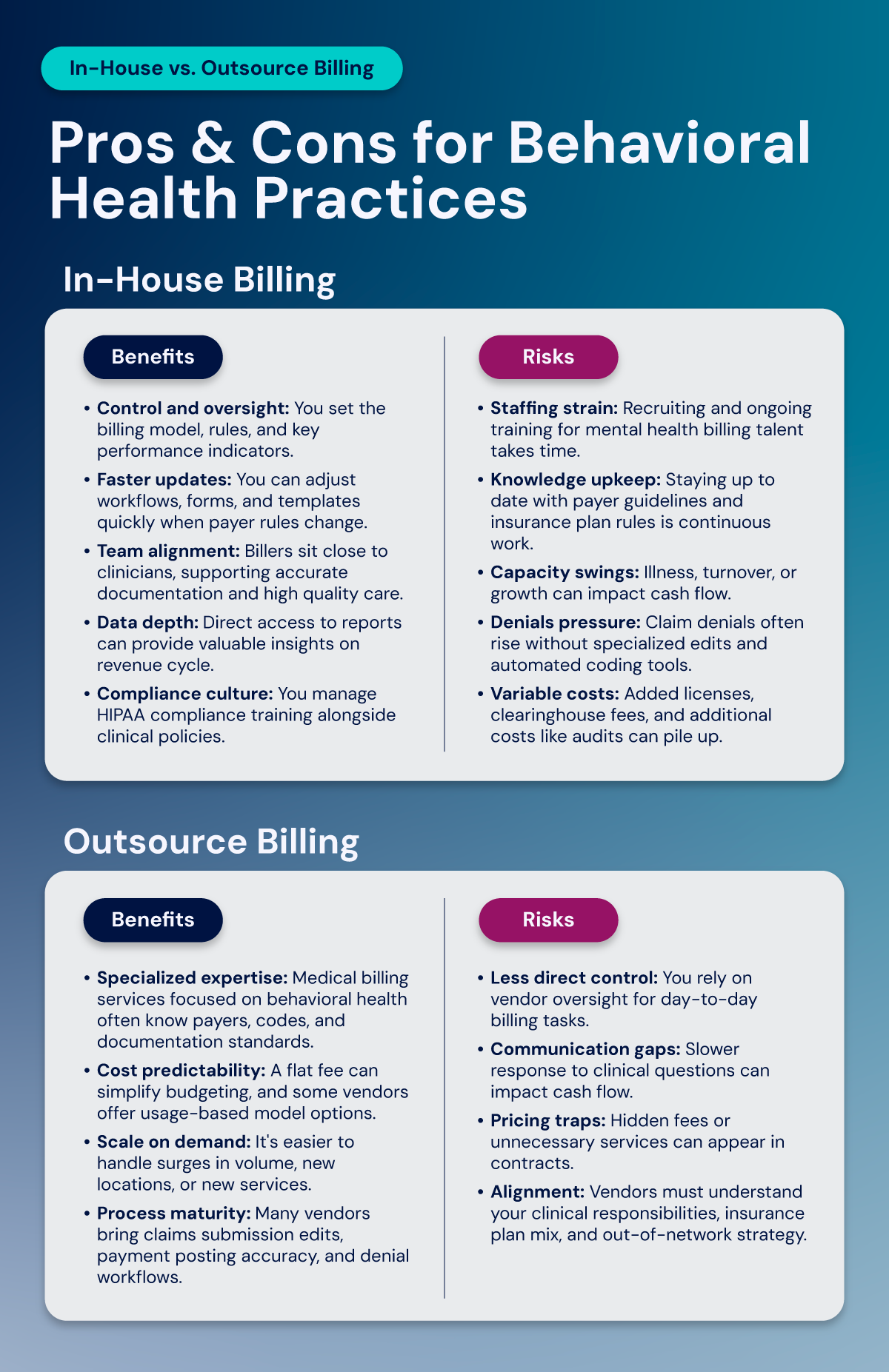
Pros and cons for behavioral health practices
Cost breakdown and staffing considerations
What drives in-house costs?
- People: Salaries, benefits, cross-coverage for vacation and turnover, and ongoing training
- Technology: Billing software licenses, clearinghouse fees, and security tools
- Management: Time spent on audits and work queues
What drives outsourced costs?
- Medical billing service rates: Often a percent of net collections, sometimes a flat fee per claim or flat monthly fee per clinician
- Pricing structures: Tiered plans based on claim volume, specialties, or added services
- Contract items: One-time fees for setup, transition support, or data extracts
Common pricing models to expect with outsourced billing services
- Percentage of collections: Simple, usage-based pricing aligns cost with revenue; confirm exactly what counts as collections
- Flat fee per claim: Predictable, good when usage patterns are steady
- Flat monthly fee: Easy to budget, often tied to FTEs; ask how scope changes impact costs
- Hybrid fee model: Mix of lower percentage plus flat fee for certain services
Need a customizable RCM setup? Talk to our team.
Optimize in-house, outsource, or go hybrid. Get the right configuration for your goals.
When RCM software can support either model
The right tools can make in-house teams faster and can help you oversee a vendor. Purpose-built behavioral health RCM tools should support:
- Eligibility and insurance verification across each insurance plan
- Coding support and automated coding rules for psychotherapy, IOP, and PHP
- Streamlined claims processing with payer-specific edits
- Workflows for denied claims
- Payment posting and reconciliation
- Reporting that surfaces valuable insights
If you prefer to keep billing internal, consider behavioral health RCM tools that fit your workflows. If you outsource, use software dashboards to monitor vendor performance and spot trends quickly.
For tighter clinical and billing alignment, an all-in-one behavioral health platform can connect scheduling, notes, authorizations, and billing tasks. That helps healthcare providers cut rework, reduce rejected claims, and support maximum reimbursement.
Decision framework checklist: which billing model fits your practice?
Use these steps to match the billing model to your needs:
1) Assess complexity
- Service mix: Psychotherapy, testing, MAT, IOP, PHP, or other healthcare providers in your network
- Payer mix: Medicaid, commercial, out of network, or value-based contracts
- Documentation: Are templates and notes standard enough for accurate documentation at scale?
2) Evaluate resources
- Team: Do you have trained staff for mental health billing and coverage for turnover?
- Tools: Does your billing software support edits, eligibility, and reporting you trust?
- Management time: Can leaders coach and audit?
3) Model the costs
- In-house: People, software, training, audits, and variable costs like overtime
- Outsourcing: Percent, flat fee, or flat monthly fee plus one time fees
4) Check the controls
- Compliance: Clarify HIPAA compliance roles and data access.
- Metrics: Define KPIs that tie to revenue streams, for example, days in AR and clean claim rate.
- Reviews: Schedule quarterly reviews.
5) Stress test the plan
- Growth: Can your billing model scale to new sites and services provided?
- Downtime: What is the backup plan if a biller leaves or a vendor misses SLAs?
- Integrations: Does your system connect with EHR notes?
Hybrid billing models explained
Hybrid billing means your team and a vendor share responsibilities. You keep some billing operations in house, and a vendor handles other parts. Common blends:
- Internal front-end, outsourced back-end: Your staff runs patient registration, benefits checks, and coding. The vendor manages claims submission, follow up, and payment posting.
- Split by payers: You keep commercial payers in house; vendor handles Medicaid or out-of-network.
- Project-based: Vendor helps clear backlogs, then hands off to your team.
Hybrid pricing options let you control the parts tied to patient care while tapping expert billing services for tougher tasks.
Learn more about mental health billing software pricing.
How Benji supports your chosen billing process
Whether you keep billing in house or partner with a vendor, Benji technology can help you manage risk, standardize workflows, and see results faster. We:
- Equip teams with behavioral health RCM tools that streamline eligibility, coding, and claims submission
- Connect clinical notes with billing in an all-in-one behavioral health platform to reduce errors and protect revenue
- Use reporting to spot trends in claim denials, find cost savings, and guide training plans
Pick the billing model that fits your goals
In-house billing gives control and fast changes if you can support staffing and tools. Outsourcing billing can add expertise and predictability if you choose clear pricing structures and guard against hidden fees. Hybrid models blend the best of both, keeping patient care close while scaling complex tasks. The right software supports billing management in any model and helps healthcare providers see results faster.